Solar did not end when the tax credit did
What actually changed for Northern California homeowners at the end of 2025, what the Prepaid PPA offers now, and how to tell in a few minutes whether your roof is a candidate.
Already know you want your home checked? Skip to the eligibility form.
What the credit did, and what it never touched
For years the federal residential clean energy credit let a homeowner who bought a solar system claim part of that cost against the federal income tax they owed. It was a real incentive and it moved a lot of people off the fence. It expired on December 31, 2025, and it cannot be claimed on a new residential system today. Anyone still pitching it is selling you on a rule that no longer exists.
Why this page mentions it at allThe credit comes up here only because so many homeowners believe it was the entire reason to go solar. It ended on December 31, 2025 and it is not part of this program or this offer.
That much travelled fast. The part that got less attention is what the credit was actually attached to. It changed the purchase price of a system, once, at tax time. It never appeared on a single PG&E statement. So when it went away, the thing that had homeowners looking at solar in the first place stayed exactly where it was.
The bill is still the bill
Rate pressure is the part homeowners in PG&E territory actually feel, statement after statement. PG&E rates are up 101 percent over the last ten years, according to CPUC ratepayer data, and the utility has already filed for another 8 percent in 2027 and 6.1 percent a year through 2030. Today the average PG&E rate sits around 48 cents per kWh.
You will not find a savings number on this page. The honest answer depends on your roof, your household, and how much electricity you use, and nobody can responsibly quote it to you from an advertisement. What can be described plainly is the structure.
What a Prepaid PPA actually is
This is not the twenty-year lease people remember from the early 2010s, the kind with an escalator clause and a payment that crept up every year. The product here is called a Prepaid PPA, and the shape of it is different: one payment, no monthly solar bill, a rate that cannot move for 25 years, and an agreement that travels with the house.
Before you askNo credit check is required to find out whether your home qualifies. Program terms and pricing are put in writing during the eligibility review.
You pay for the system once, up front. If paying at once is not practical, the amount can be financed through Travis Credit Union, and either way there is no credit check and no lien placed on your home. From there you get zero monthly solar bills for 25 years, at a rate that never moves. There is no escalator built into the agreement, so the number you agree to on day one is the number that holds for the full 25-year term.
If you sell the house before the term ends, the agreement travels with it. The next owner inherits the same zero monthly solar bills for whatever is left of the 25 years. That is worth knowing in Northern California, where people move more often than a twenty-five-year contract tends to assume.
Who this is not for
An advertisement that claims to fit every household is not worth reading, so here is where the program does not apply.
- You need to be the homeowner. Renters cannot enter the agreement, and neither can a seller mid-transaction.
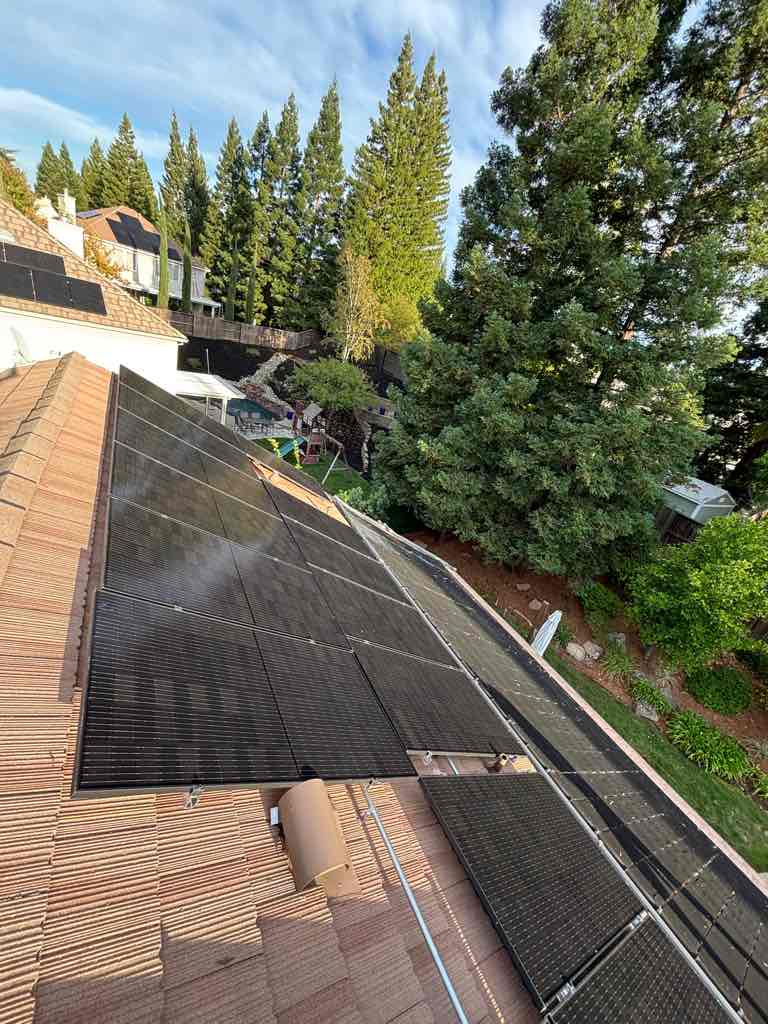
- The roof needs usable sun. Heavy shade from mature trees or a neighboring building can rule a house out, and that gets checked early rather than late.
- If the roof is near the end of its life, it usually makes sense to handle the roof first and come back afterward.
- The program is built around PG&E territory in Northern California. A home on a different utility is a different conversation.
If none of those describe your situation, the eligibility check takes a few minutes and costs you nothing.
What North Valley Solar Power does for your project
North Valley Solar Power designs and manages solar projects for Northern California homeowners. That means the system design pulled from your actual PG&E usage, the permitting paperwork, the utility coordination, and the schedule that carries a project from a signed agreement through activation. One team, one point of contact, from the first call forward.
That coordination is the actual job, and it is the reason a homeowner is not left juggling a utility, a permit office, and a project schedule on their own.
North Valley Solar Power has been locally owned since 2019. Today the company operates 15 offices across Northern California, serving 23 counties of PG&E territory. Roughly 2,500 Northern California homes have gone through the program, and the company currently holds 4.9 stars across 373 verified Google reviews.
See if your home qualifies
Four questions. No credit check to check eligibility, and no obligation attached to asking.
Would rather talk it through first? Call {{CALLRAIL_NUMBER}}.
What happens after you send it
Someone from the office nearest you reviews the address and your PG&E usage to confirm the home is a candidate. If it is, you get the design, the cost, the financing options, and the full written terms before you agree to anything at all. If it is not a candidate, you get told that plainly and that is the end of it.
See if I qualify